George Martin had never tasted Angostura bitters and soda water.
That is a strange gap for a man who would go on to build a bitters company, but it is the truth. One night at Hen of the Wood in Waterbury, his friend Eric Warnstedt put one in front of him. Soda water, a few dashes of bitters, ice. It cost almost nothing and it tasted like something.
Martin started drinking it constantly. Not as a substitute for anything. As the thing itself.
Bitter Bubble is what happened next, and it is one of the more interesting companies in non-alcoholic beverage precisely because its founders have spent five years actively declining to make it bigger.
A chef and an engineer
Eric Warnstedt is an eight-time James Beard nominee. He cofounded Hen of the Wood in Waterbury and Burlington and runs Heirloom Hospitality, which includes Doc Ponds in Stowe, Prohibition Pig and Gallus Handcrafted Pasta in Waterbury, and, more recently, Original Skiff Fish + Oysters with Burlington's Hotel Champlain.
George Martin is a Burlington engineer. His firm, LN Consulting, designs mechanical, electrical, and plumbing systems for buildings. Before that, he spent time at Citizen Cider, where he learned how a beverage actually gets made at volume. The seed of Bitter Bubble came partly from watching an expensive finishing tank at Citizen sit idle for days while fermentations ran. Somebody floated the idea of making a Vermont seltzer in the downtime. Martin could not see how it would be different from every other seltzer.
He was right. It would not have been, until Warnstedt handed him the bitters and soda.
They had been circling the idea since the early 2010s. What finally moved it was watching their own bar programs change. At Prohibition Pig and Hen of the Wood, the drink orders had drifted away from the piña colada and the Long Island iced tea and toward the Negroni. Guests were choosing bitter. Deliberately.
They committed to building it together in 2020 and launched in the summer of 2021.
What is actually in the can
Bitters were originally sold as medicine. Herbs, spices, roots, flower buds, macerated and bottled and marketed as tonics. What survived into the modern bar is a small, potent bottle you use in dashes.
Bitter Bubble's insight was to take the flavor architecture of that tradition and dilute it into something you can drink all afternoon.
The house bitter base is gentian root, chicory, and dandelion. Those are the three notes that dominate Angostura, and they run through every SKU. On top of that base sit natural extracts sourced from a New England supplier, and each flavor gets its own botanical twist. There are three:
Delicate, citrus on the nose, a distinct bitter backbone on the finish. The closest thing to Angostura and soda.
Cherry cola aromatics, more robust, then the bitter base arrives. Built for the person who drinks sweet soda.
Aromatic, floral, tropical. The one that reads simple and then keeps unfolding.
That is a genuinely unusual position. Most of what gets shelved next to it is either a sweetened craft soda or an unflavored seltzer. Bitter Bubble is neither. It is a flavored beverage with no sweetness in it at all, which is a much harder thing to make drinkable than it sounds.
One honest note on the label. When BevNET reviewed the line, they liked the product and said so, but flagged that the ingredient panel reads as carbonated water and natural flavors, and that buyers would be better served by more specificity about what is inside. That is a fair critique. If you are the kind of person who reads panels, you will notice it.
Warnstedt is the whole category in one person
Here is the part that matters commercially, and it is a little counterintuitive.
Eric Warnstedt likes alcohol. He has said plainly that he has no interest in de-alcoholized products like non-alcoholic beer. He built a bitters soda anyway, because he wanted to moderate, not abstain.
Order a Negroni. Take two sips. Top the glass off with Bitter Bubble. Then do it again.
The drink lasts twice as long. The technique works with anything booze-forward, especially builds carrying Campari or Aperol.
Sit with that for a second, because it inverts the usual pitch.
The industry has spent five years explaining that roughly 92 percent of non-alcoholic buyers also purchase alcohol, a behavior the trade calls zebra striping. NielsenIQ's 2025 year in review put the non-alcohol category past a billion dollars in sales. The Brewers Association, reading NIQ scan data, reports that non-alcoholic volume rose 111 percent and dollars rose 159 percent between 2021 and 2025, moving from 1.1 percent of beer volume to 2.5 percent.
Every operator hears those numbers and thinks about the guest who is not drinking.
Warnstedt is telling you the more valuable guest is the one who is drinking. A can that stretches a cocktail from twenty minutes to forty does not take a Negroni off the check. It adds a two-dollar can to it, keeps the guest at the bar longer, and gets them to a second cocktail they would not otherwise have ordered.
The non-alcoholic product is not the substitute. It is the pacing device.
That is a bar-program argument, not a wellness argument, and it is the strongest thing Bitter Bubble has going for it.
One caveat on the data, because the numbers deserve it. The NIQ figures track non-alcoholic beer, hop water, non-alcoholic cider, and non-alcoholic cocktails made by beer companies. An unsweetened botanical soda sits beside that measured set rather than inside it. The tailwind is real. The scoreboard is not this brand's.
The cans are the marketing budget
There was no marketing budget. There still isn't.
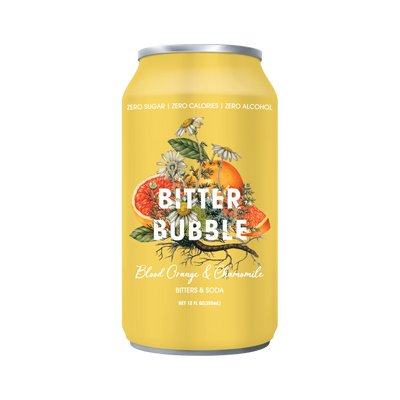
What there is instead is Dennis Healy, a Williston creative director and a friend, who drew the brand. The cans carry botanical illustrations rendered like plates from a nineteenth-century field guide. Fruit, vine, flower, taproot. Vivid background colors, one per flavor. A script flavor name under a heavy block logotype, and under that, two words: Bitters & Soda.
Dana Parseliti, who buys beverage for Honey Road and Grey Jay in Burlington, put it about as well as it can be put. The cans, she noted, do not look homespun. She was drawn in by the packaging before she ever tasted it, and stayed for the restraint of the flavors and the way the bitterness sits at the back rather than the front.
For a brand with no advertising, no taproom, and no sales team, the label has to do the work of all three. It does.
They do not want to grow
This is the fact that makes Bitter Bubble unusual, and it is not a marketing posture.
Warnstedt calls it a fun sort of garage brand. He is not being modest. Both founders have demanding full-time work. Warnstedt's is a restaurant group. Martin's is an engineering firm. Martin told Edible Vermont plainly that Warnstedt's focus is the restaurants and his own focus is his engineering practice.
That is not a typo. They work with a co-packer to fill as many orders as they can. Requests come in from around the country. They fill what they can inside New England and largely leave it there. They talk about their drinkers as a club, because at this scale they still know most of them.
Warnstedt has said that someday they will borrow money and make the thing bigger. Someday is doing a lot of work in that sentence.
Martin has floated the flavors he wants to make when there is time: birch bark, basil, cardamom. He has also talked about going the other direction, into concentrated small-format bitters for people who want to push further into the bitter void. A tasting room has been mentioned. None of it has happened.
You can read that as a failure of ambition. We read it as the reason the product is good. A brand run by two people who do not need it to succeed will never cut the bitter base to widen the audience, never add sweetener to fix the first sip, never chase a fourth SKU because a category manager asked for one. Bitter Bubble tastes exactly like what two guys wanted to drink, because there was no one else to please.
Almost nothing on the shelf can say that.
Where to find it
Bitter Bubble is distributed in Vermont by Baker Distributing and sits on shelves at City Market's Burlington locations, Healthy Living, Cheese Traders, Commodities Natural Market, the Brattleboro Food Co-op, and a scattering of mountain-town markets. Wholesale accounts order through Faire. Online, the non-alcoholic bottle shop DRAY carries the line.
Drink it cold, straight from the can, the way the founders do.
Or order a Negroni, take two sips, and pour the rest of the can in.
Brands like this are why the shelf exists.
See the portfolio- Bitter Bubble: About, home, wholesale on Faire
- Seven Days (Melissa Pasanen), Bitter Bubble Meets Demand for Sophisticated Nonalcoholic Sips (May 2025)
- Brattleboro Food Co-op (Sarah Galgano), Bitter Bubble producer profile
- Brew View VT, Bitter Bubble Bursts into the non-alcoholic scene (Oct. 2023)
- Edible Vermont, Bitter Bubble, Burlington
- BevNET, Bitter Bubble product review (Oct. 2022)
- Brewers Association, The State of Non-Alc (Jan. 2026)
- NielsenIQ